Wednesday, 11 October 2017

Bizarro Back Issues: That Time Amitabh Bachchan Was A Comic Book Superhero

At the peak of his popularity in the 70s, Amitabh Bachchan was everywhere. From films to commercials to even in politics, the 70s and the 80s belonged to Big B, long before he was even christened with that name. I’m a 90s kid, so although I did did miss out on the “angry young man” phase of the actor’s career, I’ve been fortunate enough to witness his “comeback” – with stellar performances in films like Mohabbatein (2000), Kabhi Khushi Kabhie Gham... (2001), Aks (2001), Black (2005), Sarkar (2005), Paa (2009), Piku (2015), and many more. Such was Bachchan’s popularity in the late 70s / early 80s that, as I learnt recently, he even had a comic book series under his name, where the actor would double as the vigilante Supremo. For almost two years, India Book House, under its comic book imprint Star Comics, published The Adventures of Amitabh Bachchan, which saw stories such as “The Lost Idol”, “Treasure Island”, “The Hijack”, and the one I stumbled upon recently and the one that sent me down this rabbit hole, “The Impostor”.


The comic book opens up with a handwritten note from Bachchan himself, thanking the young readers for their concern for his health. I assume this book was published after the actor’s near fatal accident on the sets of Coolie (1983). The pages on the copy I found have faded a bit, but from what I could make out, Gulzar was the “Script Consultant” on this series – yes, that Gulzar! – and a horde of writers and artists were responsible for this particular issue: Pammi Bakshi, Mohan Swaminathan, Anuradha Vaidya, Milind Mulick, Balasaheb Mandke, Shakun Chavan, and Pratap Mulick. Pammi Bakshi is credited as the “Editor/Author”, so I did a little digging. Apparently, she developed the series for India Book House, convincing Bachchan on the sets of his film Pukar (1983) to lend his name to the comics. Bachchan’s co-star in that film, Randhir Kapoor, had tagged him “Supremo” and the moniker seemed like a memorable name for a comic book character.

We are introduced to Sunil Saxena – “the prominent businessman who also has a fine record for philanthropy” – and his evil epic sideburns. In his defence though, epic sideburns were extremely popular at that time in India. We had just learnt about Elvis, you see. Three panels into his introduction and you can already tell something is fishy about this guy – it doesn’t matter that he just made a 100k donation to the Sevashram Children’s Home!


The story switches gear and we witness a daylight robbery. A gang of men with machine guns, matching uniforms, and their faces covered with handkerchiefs, storm into the State Bank Downtown branch on a busy morning. The robbers are led by Supremo himself!
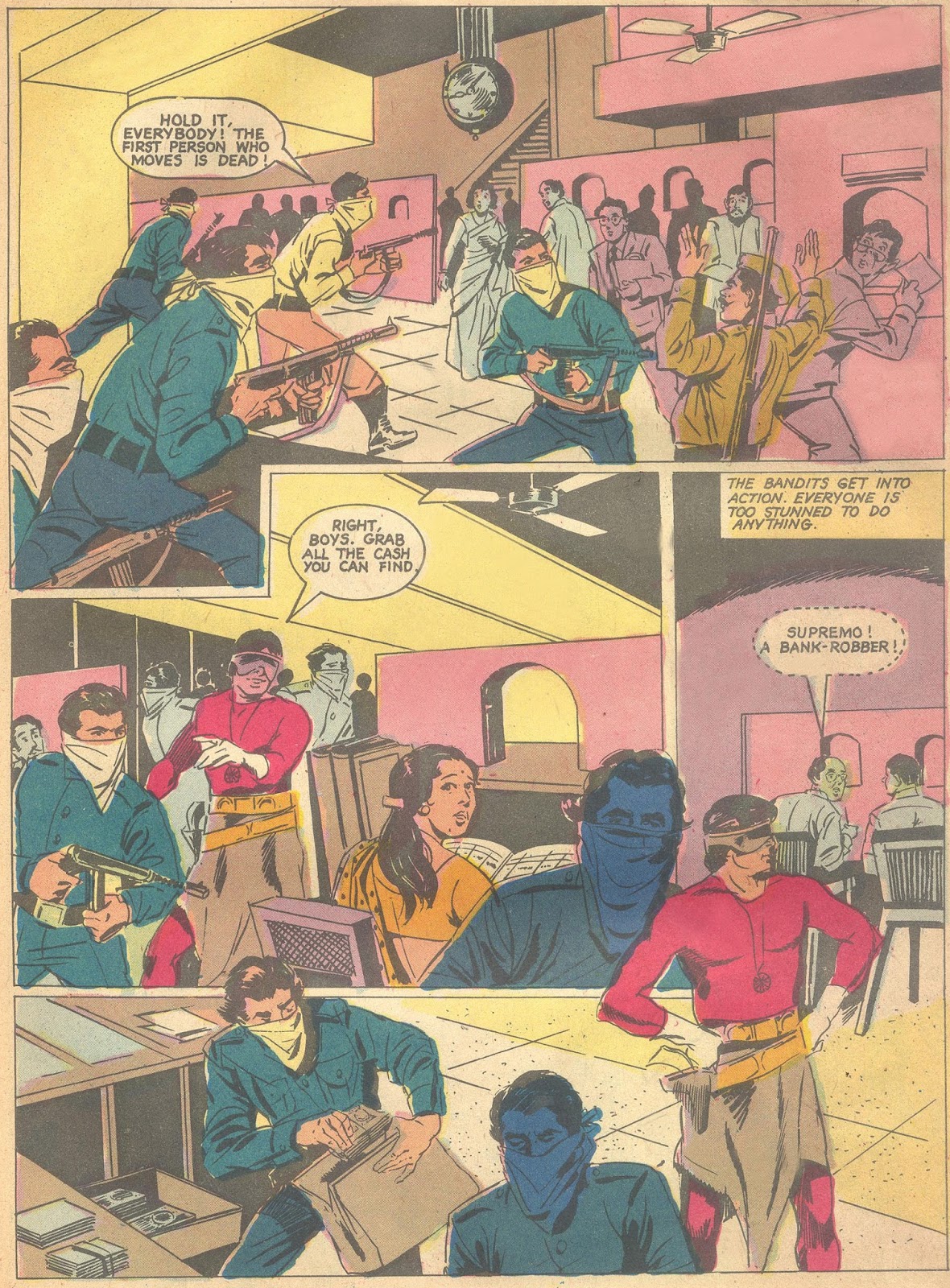

Now, this was the first time I had seen Supremo in action and, um… let me just say I was taken aback. In my humble opinion, that is a terrible costume. I’m told Bachchan himself approved it from the many designs Pratap Mullick – legendary Indian comic book artist, best known for his run on Nagraj – had sent to him; which only begs the question: Why? I get that the character was heavily influenced by The Phantom, but not everyone can rock a pink unitard. That too with a loincloth over it. I hope that pendant has some interesting history. Maybe, in true Bollywood style, it was the aakhiri nishaani of Supremo’s mother? But more than that, I hope he can see in those ridiculous… sunglasses?

Incidents of Supremo and his minions popping out of a red van like jokers out of a clown car and robbing banks, jewellery stores, etc. increase day by day. The police are baffled how “the staunchest crime fighter” they knew could turn to a life of crime. Meanwhile, Bachchan learns of the “sensational” news while shooting for a film in Kashmir. Immediately, he applies for a leave for he must investigate who is smearing mud to his good name, as we Indians say. And because he has better workers’ rights than you and I do, his leave is approved instantly.


The Phantom influence on Supremo is far more prominent than I had thought, for Supremo too has his own private island with various animals living in harmony à la “The Ghost Who Walks”. But The Phantom is not the only classic comic book character Supremo takes inspiration from. Batman has his Robins, Supremo has Vijay and Anthony. Yup, Vijay and Anthony are named after two of Bachchan's most famous roles.


Anthony dresses way better than any kid I’ve ever known, to be honest.

To learn more about his impostor, Supremo goes undercover as a journalist to interview the guards at the banks and jewellery stores that were robbed recently. His disguise looks less like that of a journalist and more like that of Matches Malone, the criminal guise Batman uses to infiltrate Gotham’s criminal world from time to time. Nonetheless, the cover works and Supremo discovers a “peculiar kind of mud” at each location where the clown bandit car was parked. He takes a sample of the mud and goes to the Central Soil Research Institute, hoping that the scientists there will help him with further analysis of the red mud.


I checked, and although we don’t have a Central Soil Research Institute, we do have a Central Soil Salinity Research Institute in Karnal, Haryana. So yeah, close enough.

As it turns out, Supremo’s hunch was correct! That “peculiar kind of mud” is indeed not found in the city. With the help of a detailed soil map, Supremo learns that that special kind of red mud is found on the northern outskirts of the city, in a thickly forested area.

Supremo goes back to island to plan his next course of action, which although turns out to be just driving his car around looking for red mud, it gives us this glorious scene of Vijay and Anthony fishing by the lake where even though Anthony has his trousers half folded and his shirt off, he still has his top hat on. This is the coolest kid I’ve ever seen!


Eventually, they stumble upon a house in the forest. Given that it was pink in colour, I don’t see why it took them so long to find it. I mean, yeah, I get it, it’s deep in the jungle and everything, but it’s painted pink! After taking out the security, Supremo and Robins Vijay & Anthony sneak into the house only to walk straight into Impostor Supremo™ and his henchmen, who look suspiciously similar to Jethalal and Bulla.


Our heroes are locked in a room where the door is “electrically operated” but the “switch is outside,” while the bad guys walk away, presumably to rob another bank. Never to succumb under pressure, Supremo quickly hatches a plan to cause a short circuit, thereby unlocking the door to their cage. While Supremo replaces the fuse so they can have some light to investigate this pink house in the middle of the jungle, Vijay and Anthony discover the robbers’ plans. Since they are laid out in simple treasure hunt map style, Supremo and Vijay & Anthony waste no time in uncovering Impostor Supremo™’s next target: The head office of the Indian Bank!

Alas, Supremo is too late and, back in the city, Impostor Supremo™ has already taken hostages inside the bank and is making ludicrous demands to the negotiators outside. When Supremo finally does arrive on the scene, I was hoping for a who is the real Supremo? dilemma, but the police, and especially the Chief of Police, are quite trustworthy of Supremo. They will recognise “the staunchest crime fighter” anywhere!

With only half an hour at their disposal to meet the robbers’ demands, the Chief of Police, in his infinite wisdom, lets a vigilante take control of the operation. Supremo’s plan? He is going to switch off the lights in the bank building and the police will then storm in, shooting anyone standing.

That… does not sound right.

Right?


What?!

Supremo races to the top of the adjacent building, where he luckily stumbles on a “thick coil of rope”. I wonder what he would have done if he hadn’t found the rope. He has no superpowers, so he can’t fly off the edge of the building or jump across tall buildings in a single bound. Clearly, planning is not one of Supremo’s superpowers.

Supremo makes a loop of one end of the rope and tries to throw it around a pipe on the roof of the bank building, but since he is no cowboy (and he has no superpowers), he fails. Repeatedly. For ten minutes.

Fortunately, Supremo’s pet falcon, Shaheen – based on the falcon Allarakha from Bachchan’s film Coolie (1983) – arrives just in time to prevent Supremo from embarrassing himself further in front of the onlookers below.


After a “deathly journey” across the road, “about three hundred feet from ground level,” Supremo reaches the roof of the bank building. He descends cautiously and makes a quick assessment of the situation, instructing Shaheen to fly around the robbers to distract them while he throws a note to one of the hostages, asking them to “lie flat on the ground” when the lights go out. It would seem that Impostor Supremo™'s minions are worse shots than Stormtroopers because none of them could shoot Shaheen down!

Supremo then proceeds to locate the main switch and has a little déjà vu.


True to their word and unlike any police I’ve ever known, the cops storm in as soon as the lights go off. Safety of the hostages be damned, shoot anyone left standing!

Nonetheless, all’s well that ends well is what we believe in here in India. Now that the Impostor Supremo™ had been caught it was time to unmask him, Scooby Doo style.


Voilà!

I told you. Those sideburns were evil.

The story ends rather abruptly, with the Chief of Police thanking Supremo, but not Vijay & Anthony. Will we see friction in the family in the next issue? The comic does end with Anthony leaning on Supremo’s car, possibly breaking the fourth wall, staring directly into our souls and probably up to some nefarious scheme.


So, perhaps we will see some friction in the family indeed. But, then again, considering that the series halted publication years ago, maybe not.

***

A slightly reworked version of this post was featured on the Brown History Newsletter. You can read the piece here.

Wednesday, 14 June 2017

Bizarro Back Issues: That Time Vampirella Took On A Death Cult's Orgy Of Destruction

You know how you are just surfing the waves of the interwebs late in the night, jumping off one strange website to another, and you stumble upon the cover to an old comic book that just grabs your attention and that image is all you can think of for days, and you just have to find that book and read it no matter what?

No? Oh. Okay.

Let me just begin by saying that contrary to what you might believe, there actually are a few comic book characters I am rather not well-informed about. Vampirella, or rather, “Vampi,” is one of them. I’ve always wanted to read a few of her stories, and I think I did go through two volumes of the Master Series (by Grant Morrison and Mark Miller, and by Warren Ellis), but she never came across as an interesting enough character for me to put down my other books and make time for her. That is, of course, until I saw this glorious cover by Jose Gonzalez.


The reason why that cover got a hold of me is because the green-face in the background, who’s watching Vampirella let out a fart, is actually traditional facemasks worn by Kathakali dancers in India. Kathakali is one of the major forms of classical Indian dance. Known for its distinct moves where equal emphasis is paid to the story the dancers are trying to convey to the audience as to the dance moves themselves, I couldn’t fathom what would lead a group of Kathakali dancers to form a death cult. Or what is an orgy of destruction is.

The story opens with a recap of Vampirella #73 and introduces us to a Hindu cult in Calcutta. Since they are “bloodthirsty believers in Shiva the God of Destruction,” it is important that they are stopped from sacrificing the young virgin with their ceremonial dagger. No, the fact that human sacrifices were never a part of Hinduism does not count. Hindus sacrifice young virgins and that is it.


Thankfully, the evil schemes of Jadoo Bindu – whose first name literally translates to “magic” in Hindi – and his Council of Wizards are stopped by Vampirella and Adam Van Helsing, who I assume is related to that other famous Van Helsing.


God bless the righteous intruders.

We jump to the present, where Vampirella is running to the apartment of Conrad Van Helsing, who has to be blind for he approves of her son’s girlfriend fashion choices. Conrad informs Vampirella that the reason he summoned her is because Adam is dying.

oh shit boi waddup

It turns out Conrad is not that powerless to save his son. He has also summoned Kala, high priestess to the Temple of Vishnu the Preserver in Allahbad, India. With a sound effect of “Phuummmf!” Kala teleports herself halfway across the world in a jiffy and lands straight into the apartments of Conrad Van Helsing. In her haste, however, it would seem she forgot to put on a top. But don’t mind that, there are lives to be saved, tops be damned!


Kala reveals that someone has stolen Adam’s soul and because they are powerful psychics in their own right, taking on them individually might not be the best course of action. Kala, Conrad and Vampirella must join forces and perform a seance and penetrate the mystical barrier around Adam. As it would turn out, the remaining members of the Council of Wizards have hatched a plot of vengeance against Vampirella and Adan Van Helsing for killing their leader. Can’t say I blame them. When you lose a leader with such a fancy name as Jadoo Bindu, your cult does lose some of its charm.


Kala explains since Adam and Vampirella’s karma is entwined and because Conrad is too old (and also blind?) for battle, Vampirella must slip into the astral plane and rescue Adam. Interestingly, no one questions Kala when she pretty much says “not my problem your boy’s in coma, gurl” to Vampirella. (That’s not what she says; calm down.) Kala guides Vampirella in the astral plane leaving her at the entrance of some sort of tunnel with, hands down the best ashirwaad ever given to someone – “may Vishnu’s smile shine on you!”

If some random rishtedaar I had never seen before had said that to me, my life would have probably been so much better.

Coming out the tunnel Vampirella was doing just fine, but she gotta be down because she wanted to save Adam Van Helsing. She meets one of the many Lords of Karma. Chosen by the “spiritual hierarchy” to decide Vampirella’s case, he informs her that his decision would be final and there would be no appeal. Read enough comic books and you know there would be an appeal somewhere down the story. What follows next is a classic beat the boss to advance to the next level story. (I can’t recall the literary term for this particular genre of stories. Sue me.) The first boss? “Yama, the Dark Angel of Death”.


Now, considering who Yama is in Hindu mythology, I was expecting an epic mystic battle of sorts between “the girl from Drakulon” and the “reaper of souls”. Instead, Vampirella recalls Kala’s advice and relies on her wiles to defeat Yama in mere two panels. Which of course is followed by a random panel of a naked woman on a “rotating bed with mirrors”.

Vampirella’s next challenge is “Shiva’s destructive wife” herself, Kali!


I’m not an expert in Hindu mythology, but I’m pretty sure Shiva was never described as Kali’s “thunderous mate”. Nevertheless, Kali is a force to reckon with. In her most famous story, she takes on an entire army of demons, destroys them all and literally dances on their corpses. So yeah, Vampirella is in trouble.

Turns out, Kali is a sweetheart. When she sees that Vampirella is willing to kill to rescue her lover, Kali lets her pass. Hindu gods are pretty chill with their followers trying to kill them for love, or so it would seem. (Love does form the core premise for a lot of Indian stories.)


Next boss fight!

Maya.


Unlike the last two times, we actually do get a battle. A psychic duel no less! Unfortunately, Vampirella’s powers are no match for the “Mistress of Illusion”. About to be cast away to the ethereal plane by the Karmic Lord who has been hanging with her and silently judging her (like all your friends), Vampirella’s makes a desperate plea to Conrad and Kala across dimensions for some extra “collective thought-wave”. Kala’s plan to rescue Adam from Maya’s spell is pretty straightforward and one that Vampirella is an expert in. If mindless pleasure has locked Adam in a comatose state, a sharp sudden pain should snap him out of it.


Maya complains to the Karmic Lord who, rather than asking her to fill in the correct form and register her complaint in the Complaint Office of Hindu Dieties™ agrees with her assessment. But before he could have his say, the Top Guy himself, Brahm makes an appearance… or rather his eye does.

I am assuming Brahm is Brahma, the Hindu god of creation, one of the three most important gods in Hinduism, and not brahm as in भ्रम, i.e., hallucinations. Although, considering the story, that might explain a lot. Nevertheless, the eye of Brahm, chill as most Hindu gods (and their organs) are, reverses the decisions of the Karmic Lord because, well, love holds no bounds.


I think that his saying that blood when spilled for the cause of love creates good karma might explain all those honour killings across the country. We should slow down, though. We are kinda overdoing it, aren’t we? What will we ever do with all this good karma?

Finally, the Eye of Brahm returns Vampirella and Adam Van Helsing to their bodies in the physical plane with the classic sound effect of “…BRAHMMM-OM-OM-OM-OM”


Sure, the story had its share of problems, but we did learn something very important today, kids. Hindu gods are chill af, but they do appreciate when lovers commit murder for each other!


Saturday, 18 March 2017

Saturday, 31 December 2016

Event Battle 2016: VALIANT’s 4001 A.D. vs MARVEL’s CIVIL WAR II vs DC’s REBIRTH

I had written a big chunk of a paragraph about how horrible 2016 was, but you and I survived, and how we should look towards 2017 with optimism. But you know what? Fuck that. You’ll hear and read about that enough for the next few days. Let’s talk comics.
Welcome to EVENT BATTLE 2016, ladies and gentlemen.
I usually pit DC’s annual crossover event against Marvel’s annual crossover event for this thing, but as you may have noticed if you follow this blog, I have recently started reading Valiant Comics as well. So, it’s not DC vs Marvel one-on-one this time, dear reader. For the first time ever, it is DC vs Marvel vs Valiant! Triple Threat Match!
(I watch a lot of pro wrestling. Get over it.)


Let us first take a look at what the new guys have to offer.
In 2016, Valiant Comics did their annual “blockbuster crossover event,” 4001 A.D. A little recap: The year 4001 holds a lot of significance to the Valiant universe. The main universe does indeed take place in present times, but 4001 is when the Spirit of New Japan, Rai, operates.
A few thousand years ago (from 4001, that is), the state of Japan rose from the ground to hover in the orbit in order to escape Earth’s relentless wars. This new floating state called itself “New Japan”. It was ruled over and run by a sentient artificial intelligence who, in what I think is a bit too on the nose, calls itself “Father”. Father provides for New Japan, taking care of the people and their needs. But as the years progress the AI gets more and more aggressive. The population is pacified with an all-seeing police and influenced by curated video entertainment. The people live in a dictatorship, but as with most dictatorships, a large section of the population is blissfully unaware. “Father will provide.”
Let’s come back to the Spirit of New Japan, Rai. Not just because I love that designation. Rai, as the tie-ins tell us, was basically an experiment by Father. Father grows one every century. Each has its own characteristics. Some are hard-working builders and creators; others are gentle, and inspire compassion among the citizens; yet there are still others who are ruthless. The 4001 AD version of Rai is the result of a lot of trial and errors. As it turns out, to create the perfect Spirit of New Japan (ha!) a feminine touch was needed. To create the perfect son, Father needed a mother. (No, you don’t have to tell me how weird that sentence sounds.)

However, once this Rai is created, Father casts aside Rai’s mother like another of his used resources. Over time, Rai learns of this and of Father’s other atrocities, and how, unknowingly, he has been enforcing Father’s vision. Determined to make up for his sins, Rai soon bands with the growing number of rebels to bring down Father. But alas, Father casts him down back on Earth. Although, not before the rebels manage to introduce a virus in Father’s core system. Weakened, Father casts away sections of New Japan, dooming millions, in order to remain strong enough to both fight the virus and keep New Japan afloat.
If that sounds a lot for a four-issue miniseries, none of the above happen in the main book. No, seriously. I could have just put in these three pages by David Mack here and you’d be up to speed.
The main book is just Rai making his way back from Earth to New Japan, with help from Lemur, Gilad and a rusty, old X-O Manowar armour to take down Father. It is as straightforward as it sounds.
The writing may be uninspiring, but the art on this book is stunning. Clayton Crain is the perfect artist to bring in the sci-fi, Blade Runner slash Ghost in the Shell vibe, exactly what this story needed. On the tie-ins books as well, Clayton Henry, Doug Braithwaite, Robert Gill, Tomás Giorello, Cafu, along with a whole platoon of inkers and colourists, knock it out of the park.
I know what you’re thinking. What about your rule to not read tie-ins to these crossover events? I hear ya, but come on, cut the new guys some slack, geez. Also, I am not as familiar with the Valiant universe as I am with say, Marvel or DC, so reading the tie-ins helped. More than anything though, one of the tie-ins gave me this glorious page so I am more than willing to let it slide this time.

Let’s take a look at what Marvel had to bring in in 2016.
Marvel’s 2016 event was called CIVIL WAR II, which, I admit, does sound like a little cashing in on the success of their 2016 summer blockbuster movie, Captain America: Civil War, and I suppose it sort of is; but Marvel didn’t disappoint me last year when they chose to reuse a title so I was curious to see what they were up to this time around.
Written by Brian Michael Bendis, with art by David Marquez, Oliver Coipel, Andrea Sorrentino, along with fantastic colours by Justin Ponser and Marcelo Maiolo, Civil War II, like the original Civil War of 2006, puts heroes against heroes. If you are unfamiliar with the current happenings of the Marvel universe, a lot of new Inhumans have been popping up all around the globe. Things get really interesting, however, when a new Inhuman, Ulysses, with the ability to foresee the future arrives on the scene.

Captain Marvel (Colonel Carol Danvers), who now leads the Ultimates, thinks using Ulysses’ abilities to prevent threats before they cause massive damage is worth the risks. Iron Man (Tony Stark), a futurist (which is an argument that is thrown at him quite a lot in this series), is a little skeptic in trusting Ulysses so blindly. He argues that Ulysses’ vision show a future and not the future. This obviously leads to some friction between  the two, but things get really nasty when Captain Marvel, acting on one of these visions by Ulysses, leads the Ultimates to battle against Thanos, without informing Iron Man or any other Avenger. The mission, as Captain Marvel herself puts it, goes “fubar”. Lives are lost and Tony loses it.
Unlike the last Civil War however, this time around it’s not Tony Stark who’s an asshole. It’s not Captain Marvel either. Her cause seems just. Her methods are not. Even after Tony points out that Ulysses’ abilities are pretty much guesswork, it is basically profiling, Carol chooses to trust those visions because even if there’s a “ten percent chance” of her being able to stop an extinction level event because she chose to believe Ulysses’ visions, it was worth it.
There are a few moments in the book that are going to split the audience. I am, obviously, not going to spoil them for you, but a lot of people die in this event. I’m interested to read if their deaths will actually mean something as Marvel Comics goes into 2017 or they were simply there for the shock value. Knowing Bendis, and I know everyone likes to shit on him these days, I think he is going to play with one of the deaths in one of the books he is writing. Overall, the writing on the book is as Bendis as it can get. His characters talk a lot, which you would assume would be perfect for a team book or an event like this, but sometimes it feels a little off. For example, I know Tony Stark is the kind of character who will crack a joke to ease the tension in the room, but sometimes it feels forced, even when it is supposed to be. Additionally, and I don’t know if this was intended, Captain Marvel’s for-Ulysses side was a lot underwritten when compared with Iron Man’s against-Ulysses side.
David Marquez shines on the book, illustrating the complete eight issues, with assistance from Oliver Coipel and Andrea Sorrentino. I love how his art ranges from simple straight lines to a lot of crosshatching when the mood changes. What more can I say for Oliver Coipel that hasn’t been said already? He’s a beast. If you have read his Thor stuff you know he can do somber character moments as good as he can do big action sequences. And please, Marvel, let Andrea Sorrentino draw Old Man Logan forever.
DC’s 2016 event was very hush-hush. It came out of nowhere. As far as I can remember there was nothing in the monthly solicitations. After Darksied War wrapped up (which I had assumed was DC’s 2016 event and I would be writing about that here), and as all of DC’s ongoings (that survived cancellation) came close to the #52 issue mark, DC announced a 80-page special by writer Geoff Johns, and artists Gary Frank, Ethan Van Sciver, Ivan Reis, Phil Jimenez, along with Joe Prado and Matt Santorelli on inks, and Brad Anderson, Jason Wright, Hi-Fi, Gabe Eltaeb on colours. It looked very ambitious for a 80-page special. Also, it seemed to be the last thing Geoff Johns would be writing for DC Comics in the foreseeable future as he would move towards overseeing their films and TV.
I not sure how to begin talking about REBIRTH. Even a quick synopsis or a blurb is spoiling it – which is why it was so hush-hush, I guess. Anyways, if you somehow still missed it, you either live under a rock or are a little too depend on this annual thingie that I do. It can’t be the latter because I don’t think anybody reads these things, I kinda do this for my own amusement, so please, get out more, maybe?
Spoilers ahead.
Rebirth brings back a lot of things. It almost feels like DC looked around and saw that some the stuff that they were doing in The New 52 age was not working – and by some, I mean almost all expect Scott Snyder and Greg Capullo’s Batman – so they decided to go back to how things were. Rebirth is all that, but somehow it is not. It is not a reset again.
Rebirth packs quite many punches in its 80 pages. None like the last page, however. It begins with a shocker. Wally West – the original Wally West, the original Kid Flash and then The Flash – is back. Or at least he’s trying to. When Barry Allen tried to correct his mistake towards the end of Flashpoint, he unknowingly set off a reset (which became The New 52). A lot of characters and relationships were gone. Wally West was one of those characters.
As it turns out, this reset should not have happened. Wally is locked out by something or someone, who, it seems, “stole ten years” from the DC timeline. Throughout the issue, Wally attempts to make connections with people who he thinks will pull him back – Batman, Linda Park, Barry Allen, to name a few. It’s a simple premise, but it is very well done. Not only does Geoff Johns does his best work in years on this issue, he manages to pay homage to Watchmen and at the same time write one of the best moments in comics of 2016.

Not to take away credits from the other artists on the issue, but Gary Frank’s work here is fantastic. Overall the art feels and looks a lot retro, yet at the same time has modern sensibilities. This is what The New 52 should have been all along. A refresh, not a reset.
THE VERDICT
To be honest, after last year’s incredible Secret Wars, I was expecting something along the same lines. While none of the three books here are Secret Wars-level good, they were fun in their own regard.
If I had to pick one, I would go with Rebirth. I was stunned when I read that issue. It came out of nowhere and shook things up. And unlike most modern events, it did not went out with little to no consequence. DC’s books post-Rebirth have been fantastic. Batman, Superman, Wonder Woman, The Flash, Green Arrow, Detective Comics, Action Comics, are all worth putting in your weekly pull list – for the first time in years!
I can’t wait to see what they do next. Alan Moore will be pissed, that’s for sure.

Monday, 4 July 2016

The Playlist Zone: PHONOGRAM

Phonogram by Kieron Gillen and Jamie McKelvie has a simple premise: what if music was magic, literally.

It is sort of a reader ritual, I suppose, that anybody who reads Phonogram makes playlists for the books. I'm no different. Here's my contribution...


Volume 1: Rue Britannia


Volume 2: The Singles Club


Volume 3: The Immaterial Girl


These playlists are as complete as possible. Every artist ever mentioned between the pages of the books is on these playlists.

Yes, even Kula Shaker.

Unfortunately, some artists like Kenickie have not made their music available on Spotify so the playlists on your device may have some gaps. I would advise adding the songs in your Local Files and then arranging them manually in the playlists.

Saturday, 18 June 2016

Valiant 101: BOOK OF DEATH

When we last left the Valiant universe, (spoilers for The Valiant:) the Eternal Warrior had took a time-displaced geomancer under his wings. Safeguarding the world’s geomancer is sort of what he does. This time around, however, he has gone AWOL leaving behind Unity and the MI-6. They soon catch up to him, though, for reasons that are revealed in a haunting double page spread brought to life by Robert Gill and David Baron.


Robert Venditti writes this ominously titled story. At regular interval, with the assistance of Doug Braithwaite and Brian Reber, he presents flashes of Valiant universe’s future. Much to Braithwaite and Reber’s credit, they do not stick with a particular character for long, making these flashes of the future exactly that. It’s interesting to see is what has become or rather, what will become of characters like Archer and Faith in these sequences. At the same time, it is interesting to see characters we are not acquainted with yet and guess how they might impact the Valiant universe.

The rest of Venditti’s script is pretty simple, though, and at times lack dimensions. Eternal Warrior’s dedication towards Tama’s protection seems rather obsessive. He seems all too dismissive to the massacres that seem to be the effects of her presence in this timeline. When Unity, more specifically, when X-O Manowar confronts him, Gilad’s words come across hollow. This obviously leads to dissension between Unity and a huge fight erupts.


After making quick work of Unity, Gilad and Tama continue their journey, reading and deciphering from Tama’s book. This eventually leads them to David, a young boy who was supposed to be the geomancer of this timeline, and prima facie Tama’s presence here and now seems to be the cause. The actual cause is soon revealed as a popular villain from the pre-Valiant, VALIANT, days makes his debut in the new universe.

When Valiant first announced Book of Death, they promised that the tie-ins will showcase how all of their major characters die. It may sound like a cheap publicity stunt to sell their books, but it’s not. The tie-ins offer exactly what Valiant promised. Every book is titled Book of Death: The Fall of (insert character’s name here), and they showcase how years from now, the eponymous character, well, falls.

The Harbinger book in particular is amazing. The psychedelic artwork of Kano elevates Joshua Dysart’s tale of one final epic battle between two of the most powerful psiots in the Valiant universe, Toyo Harada and Peter Stanchek. Kano not only captures the bright details of futuristic cities but also renders what is -- and I’m not out of words here, it is what it is – indescribable with such exquisite detail, it’s unbelievable. Every page on that comic is joy to behold.


Except Fall of Bloodshot, all tie-ins are fun. I found Bloodshot too clichéd: typical lone wolf tough guy story. Doug Braithwaite’s art is great, though.


Unlike its pessimist title, Book of Death wraps up with a hopeful denouement. The moments after the battle, especially the one immediately after, between Gilad and Tama, is wonderful and makes up for any shortcomings the book may have had.


With that, ladies and gentlemen, we wrap up this little experiment/project of mine. Thank you for joining me. This has been Valiant 101.

Wednesday, 15 June 2016

Valiant 101: DIVINITY

I'll be completely frank with you here. The only reason I read Divinity was because it sorta rhymed with Unity, and I thought this had something to do with that book.

Well! Now that we have gotten that out of the way, I must also mention that I am so glad I chose to read this because it is so good.


The book is written by Matt Kindt who, by now, I feel like is Valiant Comics' Jim Shooter 2.0 in the sense he has shaped much of their universe with important arcs and stories for quite some time now. He has built a legacy, is what I am trying to say, I guess. The story follows Abram Adams, an orphan, who is moulded by Mother Russia during the Cold War to be one of its finest... to be sent on a suicide mission to the very edge of the galaxy. Because, you know, Russia.

Although one of the reasons Abram is chosen for the mission is because he has no one to come back to -- what a sad thing to say, and in what cruel way have I written that! -- it turns out he does have someone. It is this desire of his to go back home that saves him when he is blessed by the Unknown.


Arriving back to Earth, where years have passed since his absence, Abrams uses his new powers to give people what they need, rather than what they want and starts his own cult religion. Not his intention, though. Humans are drawn to fellow charismatic humans. The MI-6 soon learns of Abram's presence and decides, in its infinite wisdom, that it would be best to confront Abram head on, who is pretty much Space Jesus.

Obviously, that does not go well for Unity, or Divinity.

Kindt not only crafts an excellent comic, but he explores a lot of themes that although rooted in the world of men and women in tights go beyond just that. At its core, Divinity is an emotional story about love, isolation and longing. At the same time, it is also a case study, an experiment or much more precisely, an investigation, if you will, of what's the weakness of an overpowered character. That is more of a writer challenge. What would bend a, what is essentially, a superman. And needless to say, I'm pretty confident Matt Kindt would write a great Superman story. Not because he could find some weakness for him (there are plenty), but because he would involve Superman in stories of emotions like Divinity.

The art on the book is by Trevor Hairsine, whose work I remembered from the action-filled Armor Hunters: Bloodshot. He is accompanied by Ryan Winn on inks and David Baron on colours. Like every Valiant book, Divinity is gorgeous. Hairsine's art is perfect for action-filled story, so seeing him take on sombre character moments was interesting. He offers incredible range here. There is a scene in the book -- and I apologise for spoiling this a bit -- where Abram slows down time for Unity members as they begin their attack on him and makes them prisoner of their own mind. That was incredibly well done. Kudos to everyone involved.


I had the digital copies of Divinity and they offer a lot of behind-the-scenes shots of the book. If you are a process monkey like me or are just mildly curious, I would recommend getting them. (I'm not sure if the hard copies also offer the same, or if the tpbs do. Be nice if they do, though.)

As I finished
Divinity I learnt that the team is coming up with a follow-up, simply titled Divinity II, which needless to say, I'll be looking forward to.