Showing posts with label comic books. Show all posts

Sunday, 8 January 2023

Do a Powerbomb: Life, Death, and Pro Wrestling

Considering how similar the two are, you would expect a significant cultural overlap between pro wrestling and comic books. Pro wrestling’s colourful characters, heightened melodrama, and rather simple ‘good vs evil’ storylines should translate easily onto the pages of a comic book, at least in theory, but that hasn’t always been the case. It is easy to see why, though. Pro wrestling is an experiential sport, that works best when you see it live with an audience, one that is losing their collective mind at every move in the ring, as you clap and cheer until you are left with a hoarse voice. Capturing that magic on paper has proven… difficult, to say the least. That being said, when Daniel Warren Johnson drops a pro wrestling comic book, you sit up and take notice.

Johnson is one of the most exciting creators working in comics right now, and has accumulated an impressive body of work in a rather short amount of time. Space-Mullet!, Extremity, Murder Falcon, Wonder Woman: Dead Earth, Beta Ray Bill: Argent Star are all worth your time and money. The visuals hook you in as you flip through the pages of these books – the perfect marriage of the hyper-detailed rendering that has become the staple of modern western comics and the sketchy, kinetic linework more commonly associated with manga – but it’s the stories, full of heart and human emotions, that make his work so special. His latest, with regular collaborators Mike Spicer and Rus Wooton, is set in the crazy world of pro wrestling. Advertised as – very ambitiously, if I may say so myself – “The Wrestler meets Dragonball Z” by the publisher, it is a passion project. Not just in terms of a creator taking their rather weird and extremely personal interest/hobby and exploring them in great detail through their work, which it very much is, but in the sense that it is designed to bring you, the readers, into pro wrestling through the inviting medium of comic books. “The goal,” as Johnson puts it in the back pages of the first issue, “is and always has been to invite people in, no matter where they’re at. So if you aren’t into pro-wrestling, damn am I glad you made it this far! And if you are into it,” which I, of course, am, “welcome, old friends!”


Looking back at his work now, it seems as if this was perhaps the book Johnson was always meant to do at some point. Pro wrestling exists in all his stories – from powerbombs in Extremity, his Eisner-nominated limited series that brought him into the spotlight, to suplexes in Beta Ray Bill: Argent Star, his last Big Two project. Death and grief exists in all his stories too, and Do a Powerbomb! is no different. This is a story of loss, and mourning, and the seven stages of grief explored over seven issues.


We begin, as all great stories often do, with a flashback. Yua Steelrose is set to defend her Tokyo Grand World Heavyweight Championship in a bout against the masked luchador Cobrasun, her once tag team partner and now bitter rival. Behind the scenes though, Yua and
Cobrasun Jacob are lovers, with wrestling being almost like a love language between them. They have a daughter, Lona, who is unaware that her dad is the “Poisonous Powerhouse” of TGPW. Perhaps a wise decision by the parents – you wouldn’t want to confuse a little kid with the backstage intricacies of pro wrestling, that when dad rains down insults on mom in the ring, he is actually playing heel (the “bad guy” in wrestling terms) – but one that would come to haunt both Jacob and Lona.

Yua is the Manami Toyota of this wrestling world – one of the greatest to ever lace up the boots and step into the squared circle. She is the face (the “good guy” in wrestling terms) in this rivalry, competing against the “high-flying scorcher” Cobrasun, whose look and in-ring gear is a cross between Jushin Thunder Liger and Kenny Omega. Johnson doesn't have a lot of pages to set up the characters, the rivalry, and the stakes for this match – the real meat of pro wrestling, if you ask me – but also, it’s not important to this story. 

So, to best use the space he has, Johnson pulls a leaf out of the pro wrestling booker playbook and gives the face an elaborate entrance – Yua’s music echoing through the arena, streamers flying into the ring, and the Kimihiko Ozaki of TGPW howling her name during the in-ring announcement. She cuts a passionate pre-match promo, the babyface’est of them all, and dedicates the match, her tenth title defence since becoming the champion, to her fans, because, since becoming a mother, she doesn’t fight for the fame and the glory, she fights for her family – and her fans are her family too. 

I told you, the babyface’est of them all. 

Boos raining down on him, Cobrasun’s entrance is cut short, in true heel fashion, by his own ego. He walks out with a hot mic in hand – “cut my music!!” – to remind the champion what the match really is for. And thus, in just a handful of pages, Johnson et al. establish what the champion stands for and what a smuck the challenger is. It’s even more impressive when you notice the subtle undertones in which the “good guy” and the “bad guy” are further crystallised in the reader’s mind. When Yua cuts her promo, the gutters are white; but when that slimy Cobrasun walks out, they are black. A nice little contrast, almost subliminal in its execution and intent, but one that adds to the narrative.

The pages that follow are the creative team at the top of their game, delivering lessons in their craft to be dissected and studied for ages like they are the trios team of Misawa, Kawada, and Kobashi back in the day. Johnson is copious in his use of speed lines, highlighting the quick pace of the match; Spicer picks a colour palette that makes the wrestlers pop on the page, thus making the action easy to follow even in the busiest of panels; and Wooton ensures you hear and feel every snap of bone. It is incredible to see a team in such precise tune with the craft of comic book making, that oftentimes becomes a relay race of sorts – writing to illustrating to colouring to lettering. 

The spectacle of pro wrestling shines throughout, especially when Cobrasun hits a gorgeous moonsault on Yua, but the real cost of the show is explored soon enough, as tragedy strikes mid-match, sudden and cruel as always, sending Lona and Jacob on to the first stage of grief.

A death in the family is often marked first by the reverberations it sends across. The shock of losing someone you love can echo out through you in strange new ways. It was a cry of anguish, at the suddenness of it all, when my mother learnt of her mother’s death, and it was an odd numbness, at death’s inevitability, when my father learnt of his mother’s. I can only hope I can muster something that is not limited to either end of that emotional spectrum when my time comes to respond to such unfortunate news, though I imagine I wouldn't have any say in it.

For little Lona, it is perhaps an odd mix of emotions, hard to pin down and difficult to process. 

I’ve been fortunate enough that my initial encounters with death have almost always been of it as an abstract idea, of something that had happened to a distant relative or a neighbour I barely knew, allowing me time to understand death, as much as one can, and see it as something unavoidable, before becoming awfully intimate with it with age. The universe doesn’t bless Lona with the same fortune and she has to come to terms with her mother’s death, and the very idea of death itself, in her own way. And thus, shock turns into denial as we see her in the present day, ten years removed from that fateful night, getting knocked around like it is day one of training at the Hart Dungeon. She has never paused to reflect on the pain she has been carrying since and has instead chosen to ignore it altogether by focusing singularly on her quest to become a pro wrestler. “I’m a Steelrose. Just like mom was,” she tells her father, “And I’m going to be just like her.”

This puts her at odds with Jacob, who just wants to see his daughter safe and healthy. But, he is grieving too, and isn’t equipped with the means to express his emotions. As Cobrasun, we see him compete in a hardcore match – a form of pro wrestling looked down upon even within the wrestling world. It is an act of self-flagellation born out of self-loathing; a broken man, punishing himself for things, ultimately, far beyond his control. He holds himself responsible for his wife’s death, for that unfortunate slip from the top rope that night, and hides the pain of losing his love behind a literal mask, burying his guilt deep within him.

Grief fractures Jacob and Lona’s relationship. They lash out at each other often – the father mistaking his daughter’s determination for stubbornness, the daughter mistaking her father’s concerns for restraints. Their equation reminds me of Jerome and Thea’s a lot, the father-daughter duo from Extremity. While in Extremity, Jerome was actively pushing his daughter into a world of violence, for that is all he knew, in Do a Powerbomb!, Jacob tries to keep his away, for he knows that world all too well. In the end, unfortunately, both men end up estranging their daughters when they need them the most.

This is a common theme in Johnson’s work, from Extremity to Murder Falcon to Do a Powerbomb!, of how in our sorrow, we tend to push people away and inadvertently hurt those closest to us. It is a frustrating state of affairs, and one that I am quite familiar with. Grief torments you, isolates you, and eats away at you. In the days following my grandfather’s death, I cut myself off from the world. I never spoke about his death, declining to participate in family evenings to share his memories over and ignoring conversations with friends who just wanted to check in on me. Not because I didn’t love him, which I very much did, and do, but because that felt like the right thing to do at that time. I couldn't be with him during his last few days, when an ugly disease had turned him into a shell of the man he was, so suffering through this pain alone was my sentence to myself. It looks silly in hindsight, a grieving boy’s lambast against the hand the universe had dealt him, and I wish I knew better. I wish I had opened myself to the emotions I was feeling but didn’t have the means to process. I wish I had asked for help.

This is also something Johnson is keen on exploring with his work, from Extremity to Murder Falcon to Do a Powerbomb!, of how perhaps the only way to work through suffering is to open up to love. It is a lesson I learnt with time, as I saw the errors of my ways. Everyone grieves differently and, of course, there is no “wrong” way to grieve, but, in the days following my grandfather’s death, I was channelling my energy into my anger, on the unfairness of it all, when I should have channelled it to celebrate his life and his memory, especially with my father, on whom that loss was perhaps the hardest, and who could have used my companionship to chart the rough waters of grief back then. So it is what Lona says to her father at the end of it all, after in their grief they make a Faustian bargain with a mysterious promoter, that sticks with me: “We lost so much time.”

Acceptance is the last of the seven stages of grief. It does not equate to happiness. I doubt one can ever truly be “happy” after death rocks your world. Rather, acceptance is the stage where you make a conscious decision to move on and strive for a feeling of normalcy again. It is not easy. It can’t be, after all. But Johnson argues through his work that acceptance is never about submitting to the challenges life throws at you or even tackling them head-on alone. Rather, it is accepting the inherent fragility of life, accepting your sheer humanity, and accepting love even when that word seems to lose all sense of meaning to you.


I am, like most people who are into pro wrestling, a born-again fan. I was too young to get into it back in the glory days of the
Attitude Era, but I didn’t miss the train entirely. In the tail end of the 90s, when the World Wrestling Entertainment (WWE) finally won the Monday Night Wars, solidifying its monopoly on the pro wrestling industry, it launched SmackDown – on Thursdays, before eventually moving it to its permanent home to Fridays – starring, mostly, wrestlers it had acquired from the company it had put to the ground, World Championship Wrestling (WCW). Wrestlers like Eddie Guerrero and Rey Mysterio were real-life superheroes to this then ten year-old and the stories were unlike anything Bendis was doing at that time, for sure. I was hooked, for life. Or so I thought.

When a company establishes a monopoly over its industry, it is not just eliminating competition, it is eliminating innovation. And that is precisely what happened when WWE became the juggernaut of the pro wrestling business as the 2000s rolled over and into the 2010s. The stories, the drama, the action – things that make pro wrestling special – were given a corporate gloss and “sports entertainment” was firmly established in the wrestling canon. That messy, probably age-inappropriate, thing I loved, that I was convinced was an artform, was nowhere to be found. But, as we all have learned in the age of Disneys and Amazons, if you want the good stuff, and not industrialised nostalgia, you have to go look it up in uncharted territories. 


New Japan Pro Wrestling (NJPW) reignited my love for pro wrestling years later. I had moved to a new country and found myself having to define again what made me, well, me. I gravitated towards the interests I had developed as a young adult, of course, but also rekindled with hobbies I thought I had grown out of. And so, in those early lonely days in a strange new country, comic books and pro wrestling became my closest friends. But, much like all friends, they were a constant source of both comfort and embarrassment. Pro wrestling, in particular.


It’s not easy to love pro wrestling. As a fan, you are well aware of how silly it looks; which, in turn, makes it difficult to invite people in. I always have a hard time articulating why I love pro wrestling. My attempts turn into either an awkward defence of its absurdity or an ironic embracement of it. Do a Powerbomb! made me realise that the reason I love pro wrestling is not just the vibrant characters, the moves in the ring, and the spectacle of it all. I love pro wrestling for the same reason I love comic books. I love stories.


***

A slightly reworked version of this post was featured on Comic Book Herald. You can read the piece here.

Friday, 14 October 2022

Sunday, 12 June 2022

In Panel Sight: Daniel Warren Johnson

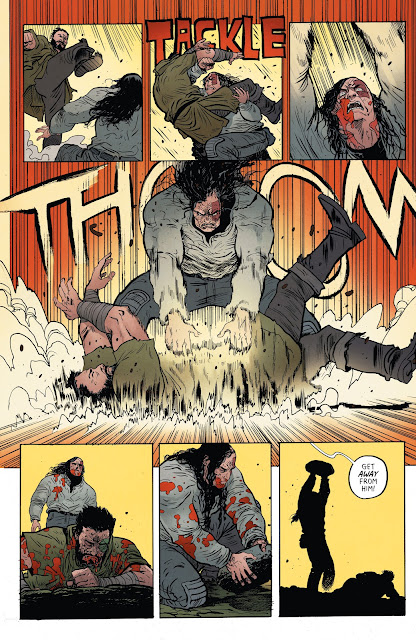
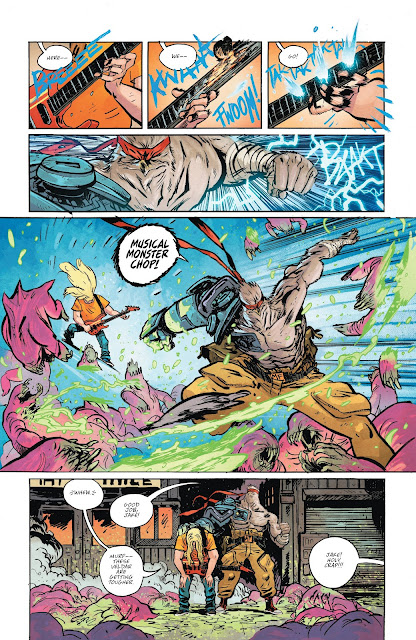
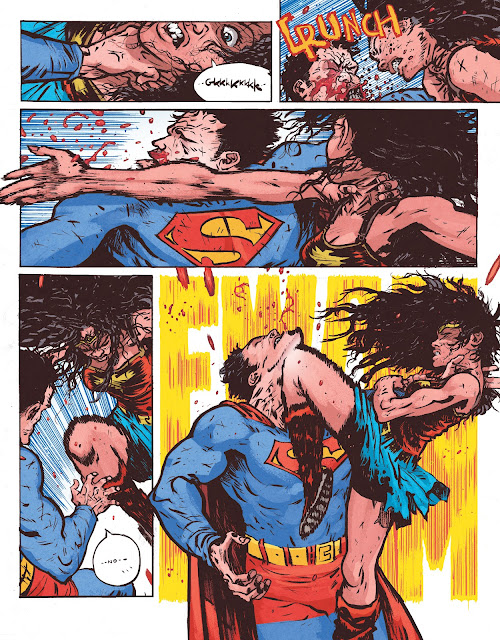
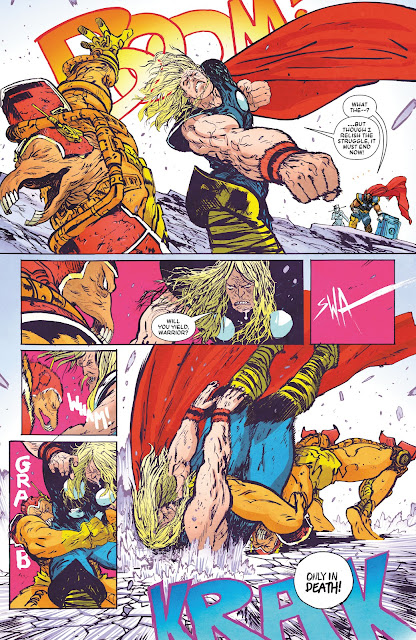
With Daniel Warren Johnson setting his next book in the crazy world of pro wrestling, here's a look at some of the wrestling moves referenced in his previous works – from powerbombs to suplexes.


Extremity
Extremity

Murder Falcon
Murder Falcon

Wonder Woman: Dead Earth


Beta Ray Bill: Argent Star

Darwyn Cooke and the Art of Genre Storytelling

One of my silly little “reading goals” for 2022 was revisiting all things Darwyn Cooke – from his early work on Catwoman to the Parker novels late into his career. Cooke is, in my opinion, a giant of the medium. Compared to his peers, he ventured into comics quite late, after spending years as a graphic designer for magazines in Canada and then as a storyboard artist in Los Angeles for various shows of the DCAU. But what that also meant was that he was able to bring in and apply the lessons learnt and experience gained from those industries into his comics. His character design is timeless – look no further than his character sheet for Selina Kyle / Catwoman – and his storytelling is sharp and crisp.
 

Going through Cooke’s works as I did, you can see a clear fascination for the look and style of post-war America – the architecture, the cars, the furniture – but, unlike most creators who choose to set their works in that time period, Cooke wasn’t shy to deal with the things America likes to ignore when it takes a look back at its “Golden Age” racism, McCarthyism, war and its consequences. In fact, in the annotations for The New Frontier, Cooke’s epic for DC Comics that tries to bridge the gap between its Golden Age and Silver Age characters, he writes: “Any effort to insinuate the DCU into the real world of the 1950s wouldn’t have been complete without looking at the civil rights issues of the day. The problem was DC catered to white culture and there were very few black characters to explore this theme.” Cooke settled on John Henry, but that comment offers us a look behind the curtain, so to speak, at the man himself.

Another point of note, as you go through Cooke’s work as I did and perhaps this is something that becomes quite obvious when you consume a creator’s work in one go is you can see how they were at three prominent stages of their career – the beginning, when they had just broken into the industry; the middle, when they were at the height of their powers; and the end. And while it would be interesting to compare those three eras of Cooke’s career, I am more interested in discussing something else that caught my eye.

You can break Cooke’s work into three categories, or genres, if you’d like: superheroes, crime, and the intersection of superheroes and crime. Specifically, I am interested in understanding how Cooke tweaked his storytelling, particularly the panel work, when he was doing a superhero epic (DC: The New Frontier), when he was doing a heist story (Richard Stark’s Parker: The Score), and when he was doing a heist story set in the world of superheroes (Catwoman: Selina’s Big Score).

We begin with Selina’s Big Score. Released in 2002, it is a 96-page graphic novel that acts as a prelude to the 2001 Catwoman series, of which Cooke illustrated the first arc (#1-4, “Anodyne”). Even though it is from a publisher that predominantly puts out superhero comics and features characters from that world, you could argue that Selina’s Big Score is, essentially, a crime comic book. That is true not because there aren’t any caped crusaders in this story, but because of how the book looks as you flip through its pages.


Traditionally, there are certain elements that creators tend to employ in a crime comic book story. You will see heavy shadows, tight panels, and the occasional shift in perspective with clever use of Dutch angles. While you will get plenty of those in Selina’s Big Score, it struck me how a big chunk of the book is done in a tight four-tier per page structure, almost as if Cooke chooses to limit himself to that. This is quite unusual because most comic book pages follow a three-tier structure: setup, beat, punchline. A four-tier structure, particularly the one Cooke employs throughout Selina’s Big Score, that of twelve panels per page, can feel overwhelming – there is simply too much going on on a page. It speaks volumes on Cooke’s command of his storytelling that it isn’t so in this book. You will see panels on panels, stacked one over the other, but it never gets in the way of the scene that Cooke is trying to tell on that page.

Consider the following page. This is early in the book, as we are introduced to the characters that make up the story and to the elements of the heist that they are trying to pull off. Here, Cooke establishes the location in the first panel and then uses shot / reverse shot to let us know that there is a certain level of distrust between the players here, as we watch this verbal tennis match of wits between them. You don’t even need to read the dialogues on this page to know who wins that tennis match; it is already conveyed through the characters’ body language. Chantel starts off strong, pointing at and pushing into Selina’s space, so much so that the cool and collected Catwoman has to rise up to meet Chantel’s challenge, gradually “moving” from her place in the lower-left corner of her panels to ever so slightly towards the right, ending on a panel with absolute focus on her, essentially outmanoeuvring Chantel at her own game and coming on top. This is reinforced in how Cooke keeps Selina on the centre of the page – it’s still her show. At the same time, on an already loaded page brimming with word balloons and subtle character work, he somehow also manages to dedicate an entire panel for a stylized introduction to Chantel, a common troupe of heist films.


Next up is the 2004 limited series The New Frontier. As I mentioned earlier, this is Cooke’s superhero epic that aims to bring DC Comics’ Golden Age characters – Superman, Batman, Wonder Woman – into the 60s and introduce its Silver Age characters – Flash, Green Lantern, Martian Manhunter. Much like how Cooke employed the tried and tested tools of crime comic storytelling but then built on those for Selina’s Big Score, he does so with superhero comics in The New Frontier. For example, while over the years, “realism” has become the norm in superhero comics, with artists adding as many details as humanly possible into the tiniest panel, the core idea hasn’t changed: You want clean lines that make it easy for the readers to follow the action, especially when you are doing big action sequences. Cooke does plenty of that in The New Frontier, but clean lines aren’t the only thing that make this book so good.

Cooke follows a strict three widescreen panels per page structure throughout The New Frontier. It feels like a cross between the then and the now, between the three-panel structure reminiscent of classic newspaper strips, that offered a clear setup, beat, punchline all in one go, and the “widescreen comics” popularized by Bryan Hitch in the late 1990s / early 2000s with his work on The Authority and The Ultimates.

Take a look at the page below. Even without the context, you get a clear idea of what’s going on here. The first panel sets up not just the location, so you know where we are in the story’s world, but it also informs you of the sheer scale of the things at stake here. You see this grisly mixture of fire and water – of burning human and alien flesh falling into this great wave off the Atlantic – punctuated by a red superhuman streak. The second panel is the beat, that adds to the plot and gives you the additional details you might need to fully contextualize the scene here.

It looks deceivingly simple, but this is something that is incredibly hard to pull off right. It is a testament of Cooke’s mastery over his storytelling that he makes it look so easy. Almost every page in The New Frontier is either a standalone or stands on its own in the scene Cooke is trying to tell over multiple pages. Even when he breaks the three-panel structure, he follows the same structure within the panel he broke it for. At the same time, restricting yourself to a particular structure/layout throughout a book also means that when you do break the mould for a splash or a double spread, it hits the reader with twice the impact. Once you realise that you also start to understand why Cooke may have chosen to stick with that three widescreen panels per page structure so vehemently throughout The New Frontier.

Finally, we look at the Parker novels. In 2009, IDW Publishing contracted Cooke to adapt four novels from Donald E. Westlake’s Parker series. Parker is Westlake’s – the grandmaster of crime fiction – most famous creation, starring in over twenty novels Westlake wrote under the “Richard Stark” pseudonym. While all four of Cooke’s adaptations – The Hunter, The Outfit, The Score, Slayground – are excellent in their own right, I want to discuss the third book in that series, The Score, since it is a heist story, front and centre, much like how Selina’s Big Score is, except that it is not set in the world of superheroes.

Coming off Selina’s Big Score and The New Frontier, the first thing you notice as you flip through the pages of The Score is how it looks like it is the best of both worlds – Cooke still does tight panels because it is a crime comic book story, but perhaps also applies the lessons learnt from his work on superhero comics to open it up when it fits. The heavy shadows are even heavier, the stylized introductions even more stylized, but the overall panel structure feels looser and, dare I say, less restrictive. A “looser” structure, so to speak, also allows Cooke to experiment and, I would argue, adapt from his source better.

Let’s consider an example. Take a look at this page from The Score. Much like the page we discussed for Selina’s Big Score, this is early in the book, before the heist. Notice how Cooke plays with the layout here. We open with a wide panel that introduces three new characters in one go. Parker knows Grofield and Wycza already, so we get a tight on the three of them in the next tier of the page where the central idea of the scene is reinforced with the panel right in the centre of the page: "Are you in, Parker?" This panel is flagged by two on either side, offering a stylized introduction to the characters we just met – again, as we established before, a common troupe of heist films. We go to a wide again where, essentially, it is two scenes in one. We get the continuation of the chat from the previous panels and we see that the players are being called into the next room.

Cooke could have broken this page down, into a nine-panel grid, for example. Here, the first tier could be: panel one, Paulus escorting Parker into the room, ending with that “I’ll go grab some beer and we’ll get going"; panel two, tight on the players Parker already knows; and panel three with a peek into the hall, a tease of the things to come. The second tier remains the same, while the third tier is broken down in a somewhat similar fashion as the first one: tight on Parker as we learn he is still unsure of participation in this job; Grofield joking to no one in particular; and the last panel that acts as scene transition to the next page, with the players turning their heads around on that "Gentlemen, can you come in here?" call. You can see that it could work, and while I do love me some nine-panel grid, doing those two scenes in wide panels feels more natural, as if many things are happening at the same moment.

These are some very specific examples, with a particular eye towards the way he structures his page and breaks it down into panels for stories across different genres, but there is a lot of cool stuff lurking under the pages of Cooke’s impressive body of work. There is a lot you could learn about this medium and how to use the elements of it to your advantage. For example, hunt down Detective Comics #439 (1974) for "Night of the Stalker!" by Steve Englehart, Vin and Sal Amendola, et al. and then see Cooke remake it as "Déjà Vu" in Solo #5 (2005) for an absolute masterclass on how to do more with less.

***

A slightly reworked version of this post was featured on Comic Book Herald. You can read the piece here.