Thursday, 27 August 2020

In Panel Sight: The "17-year running gag" in Brian Michael Bendis's Spider-Man run


Ultimate Spider-Man #81

Ultimate Spider-Man Annual #2

Ultimate Spider-Man #110

Ultimate Spider-Man #122

Ultimate Spider-Man Annual #3

Ultimate Spider-Man #130

Ultimate Comics: Spider-Man #5

Ultimate Comics: Spider-Man #8

Ultimate Comics: Spider-Man #16.1

Miles Morales: Ultimate Spider-Man #3

Miles Morales: Ultimate-Spider-Man #12

Spider-Man: Miles Morales #5

BONUS:

The Defenders (2017) #009

Thursday, 8 August 2019

The Playlist Zone: BOLLYWOOD: THROUGH THE AGES

2019 saw me finally give in and build the massive playlist I've been taking about doing since forever. One song per year, 1947 to present, to capture the evolution of Bollywood music.


There is some obvious bias here and there are obviously some rules to it. I'm not going to bother you with either. However, I've realised music on these streaming services is... temporary, for the lack of a better word. So, the following is a complete listing of the tracks in the playlist. I've tried to include video links for each song also, since I think it's interesting to see how our use of music in our films has changed through the years. (Yes, I do realise the temporary nature of these video hosting sites as well.)

Song Film Year
Hum Ko Tumhara Hi Aasra Sajan 1947
Gaaye Ja Geet Milan Ke Mela 1948
Saajan Ki Galiyan Chhod Chale Bazaar 1949
Ae Dil Mujhe Aisi Jagah Le Chal Arzoo 1950
Awara Hoon Awaara 1951
Yeh Raat Yeh Chandni Jaal 1952
Yeh Zindagi Usiki Hai Anarkali 1953
Kabhi Aar Kabhi Paar Aar Paar 1954
Pyar Hua Iqrar Hua Shree 420 1955
Leke Pahla Pahla Pyar C.I.D. 1956
Uden Jab Jab Zulfen Teri Naya Daur 1957
Hai Apna Dil To Aawara Solva Saal 1958
Haal Kaisa Hai Janab Ka Chalti Ka Naam Gaadi 1959
Pyar Kiya To Darna Kiya Mughal-E-Azam 1960
Abhi Na Jao Chhod Kar Hum Dono 1961
Aap Ki Nazron Ne Samjha Anpadh 1962
Jo Wada Kiya Woh Nibhana Padega Taj Mahal 1963
Taarif Karoon Kya Uski Kashmir Ki Kali 1964
Aaj Phir Jeene Ki Tamanna Hai Guide 1965
O Haseena Zulfonwale Jane Jahan Teesri Manzil 1966
Tum Agar Saath Dena Ka Vada Karo Hamraaz 1967
Aajkal Tere Mere Pyar Ke Charche Brahmachari 1968
Mere Sapnon Ki Rani Aradhana 1969
Rangeela Re Prem Pujari 1970
Yeh Jo Mohabbat Hai Kati Patang 1971
Inhin Logon Ne Pakeezah 1972
Chura Liya Hai Tumne Jo Dil Ko Yaadon Ki Baaraat 1973
Jai Jai Shiv Shankar Aap Ki Kasam 1974
Tere Bina Zindagi Se Aandhi 1975
Kabhi Kabhi Mere Dil Mein Kabhie Kabhie 1976
Bachna Ae Hasinon Lo Main Aa Gaya Hum Kisise Kum Naheen 1977
Salame Ishq Meri Jaan Muqaddar Ka Sikandar 1978
Ho Pardesia Mr Natwarlal 1979
Dard-E-Dil Dard-E-Jigar Karz 1980
In Ankhon Ki Masti Umrao Jaan 1981
Dilbar Mere Satte Pe Satta 1982
Nainon Men Sapna Himmatwala 1983
Intaha Ho Gai Intezar Ki Sharaabi 1984
Saagar Jaisi Aankhonwali Saagar 1985
Mera Kuchh Samaan Ijaazat 1986
Kate Nahin Kat Te Mr. India 1987
Gazab Ka Hai Din Qayamat Se Qayamat Tak 1988
Dil Deewana Maine Pyar Kiya 1989
Mujhe Neend Na Aaye Dil 1990
Dekha Hai Pehli Baar Saajan 1991
Yeh Haseen Vadiyan Yeh Khula Aasman Roja 1992
Choli Ke Peeche Khal Nayak 1993
Ek Ladki Ko Dekha 1942 A Love Story 1994
Tujhe Dekha To Dilwale Dulhania Le Jayenge 1995
Chappa Chappa Maachis 1996
Are Re Are Dil To Pagal Hai 1997
Chaiyya Chaiyya Dil Se 1998
Taal Se Taal Taal 1999
Dil Ne Yeh Kaha Hain Dil Se Dhadkan 2000
Radha Kaise Na Jale Lagaan 2001
Aye Udi Udi Udi Saathiya 2002
Jadu Hai Nasha Hai Jism 2003
Kabhi Neem Neem Yuva 2004
Kajra Re Bunty Aur Babli 2005
Luka Chuppi Rang De Basanti 2006
Maula Mere Maula Anwar 2007
Pehli Nazar Mein Race 2008
Dhan Te Nan Kaminey 2009
Dil To Bachcha Hai Ishqiya 2010
Kun Faya Kun Rockstar 2011
Taar Bijli Gangs of Wasseypur 2012
Kabira Yeh Jawaani Hai Deewani 2013
Muskurane Citylights 2014
Ka Kha Gha Bombay Velvet 2015
Channa Mereya Ae Dil Hai Mushkil 2016
Baarish Half Girlfriend 2017
Aaj Se Teri Padman 2018
Azadi Gully Boy 2019
Mehrama Love Aaj Kal 2020 
Kabhii Tumhhe Shershaah 2021 

Wednesday, 26 September 2018

Event Battle 2017: DC’s DARK NIGHTS: METAL vs MARVEL’s SECRET EMPIRE

I know I said that this would be an annual thing, and I’ll try to keep this on schedule, and I’ll try to post these on time, and I know I’m posting the one for 2017 as 2018 comes to an end… but writing this took a backseat as I had to finish some projects and write a thesis. C'est la vie, as the French say.

So, since I obviously can't keep this on schedule, and this doesn't deserve to get stuck in limbo, welcome to the final edition of EVENT BATTLE, ladies and gentlemen. Thank you for sticking around.
Last time we had what I called a Triple Threat Match: DC vs Marvel vs Valiant. While I was hoping this would be a trend going forward, Valiant Comics took a break from publishing big summer crossover events this year. (Side note: I absolutely adore Valiant’s quality over quantity strategy, and I hope it continues despite the recent setbacks.)

So, back to the heavyweights, then?


2017 saw DC Comics handing over their universe to the most successful team off their New 52 experiment, Scott Snyder and Greg Capullo (of the Batman fame), in the form of METAL, or Dark Nights: Metal. While Metal is indeed a continuation of Snyder and Capullo’s run on Batman, it does build itself up on the shoulders of giants. Peter Milligan and Kieron Dwyer’s “Dark Knight, Dark City” being one, Grant Morrison’s seminal run on Batman, Final Crisis, his The Multiversity stuff, and pretty much the entirety of his DC output is some of the few important stories from the past that the creators wove into theirs. However, although Metal leans on and borrows from a lot of stories (like most modern superhero stories do), it does not make them a required reading. You will easily find your way if you have never read “Dark Knight, Dark City” (you should, though) and don’t know who or what Barbathos is. Metal is that accessible to new readers. If you are a long-time reader and know your comics, however, it is oddly satisfying when you catch a reference.

Like I mentioned earlier, Metal brings back Barbathos, the bat daemon occultists in 1776 (including the third President of the UnitedStates of America!) tried summoning with their “Ceremony of the Bat”. Bruce Wayne, because of his connection to both the Wayne family and, well, I guess, bats in general, is revealed to be the host for Barbathos’ return. To act as the portal/host for the daemon, Wayne needs to be exposed to five divine metals. It is revealed later that Batman already has been exposed to most of them in previous storylines (Electrum in “Court of Owls”, Dionesium in “Endgame”, Promethium in “Superheavy”, Nth Metal in the prologue of the event with Dark Nights: Casting and Dark Nights: Forge, and finally, Batmanium during the course of this story). The daemon, of course, has evil intentions. It is bringing with itself the “dark multiverse”. It literally wants to sink the Earth and flip the scales.


Oh, and also, it is bringing with itself the twisted versions of Batman… who kinda do look awfully similar to Dark Judges from Judge Dredd?


As you can imagine, much of the story then follows Batman and the Justice League’s attempt at stopping Barbathos and his horde of mercenaries. Metal is filled to the brim with ridiculously absurd and deliciously fun moments throughout. While I did stick with my rule of not reading the tie-ins for events, I did read those that Snyder co-wrote, and they work quite well with the main story. They offer details to the story as you would expect from a tie-in but if you do choose to follow the main book only, you would be good.

While bigger, louder, more ridiculous seems to Snyder’s modus operandi for every story after “Zero Year”, it just kinda works here. Rarely does the story pauses and the characters get a chance to breathe. Even the dialogues are written in such a way that they service the plot forward and not add any depth to the characters themselves. While this does seem to continue on his Justice League run, what I do appreciate here is how he managed to adapt and extend previous stories and add more layers to the cosmic side of the DC Universe, which I have always felt falls a bit short when compared to Marvel. Apart from Darkseid and the New Gods, there’s not much else to it, is there? (Cue fans telling me off in 3… 2… 1…)

Greg Capullo draws every issue of Metal, front to back. This in itself is unheard of for modern superhero crossover events, but that’s not all. The man knocks it out of the park throughout. From huge action splash pages to an eight panel page of a tightly choreographed fight scene, Capullo works his magic throughout. Joining him on the tie-ins are John Romita Jr., Andy Kubert, Jim Lee, Doug Mahnke, Yanick Paquette, Jorge Jiménez, Riley Rossmo, Howard Porter, Bryan Hitch, Mikel Janín, and a host of talented inkers and colourists. While on some scenes in the tie-ins, the transitions between the artists is not subtle and it feels a bit off, the books are a sight to behold. If Jorge Jiménez’s work on Superman, Super-Sons, etc. didn’t inform you, the guy is a superstar.


Marvel, on the other hand, had a rough year. I’m talking about the comic book side of the business, of course. They seem to be doing just fine everywhere else.

SECRET EMPIRE is the continuation of Nick Spencer’s Captain America run, specifically his ‘Hydra Cap’ storyline. You know, the one that caused so much outrage. I wasn’t following his run then, but reading this event now, I learnt that (spoiler alert:) that man is that controversial panel actually is Steve Rogers. While the story very firmly establishes that it is not an LMD, not a clone, not a shape-shifter, etc., that man is still not our Captain America. Something is a bit off – specifically, Rogers gets his history rewritten by a sentient cosmic cube – and this leads to an interesting “What If?” storyline, almost.


Yes, Captain America is a Hydra agent. The bad guys have won. America is under Nazi rule (Which, is not that different from the current state of things, is it?). Spencer’s plays with this idea throughout the story, drawing parallels between the two. For example, the persecution of the Inhumans in the make-believe world is drawn from the persecution of the Jews in the real, and so on. While the story is not that epic in scale as Metal perhaps is, it does work as a summer blockbuster crossover event story regardless. Spencer also smartly limits the active cast. New York is put under a blackout, so half the Marvel superheroes are off the table and a shield around Earth has locked out heavy-hitters like Captain Marvel and such. This makes it easier to follow the action. Not that I doubt Spencer’s ability to write a large cast (he does exactly that so expertly here) or that I doubt the reader’s ability to read a book with a large cast. A smaller cast works here, because unlike Metal, for example, this is not a story about the heroes trying to stop the bad guys from winning. They have won already. It is up to a handful of rebels to overthrow the regime Reich.


The first and the last issue of the story is drawn by Steve McNiven, and rest of the work is divided among Rod Reis, Daniel Acuña, Andrea Sorrentino, Joshua Cassara, Leinil Francis Yu, Sean Izaakse, Joe Bennett, Ron Lim, Paco Medina, …holy shit that’s a lot of artists. To their credit though, the editorial team does manage to avoid any art inconsistencies. The story follows the one artist per issue rule to the dot, or a specific artist(s) sticks with a particular plotline. Steve McNiven hyper-detailed art sets up the mood perfectly in the beginning and that exposition is perfect for the end. Andrea Sorrentino, I think, handles a major portion of the book. His panel structure and innovative use of the borders and the gutters is fantastic.


THE VERDICT

To be honest, this was the hardest it has been in quite some time to pick one of the two. Usually, I like one book over the other a lot. Infinity over Forever Evil, Original Sin over Futures End, Secret Wars over Convergence, Rebirth over Civil War II and 4001 A.D. This year, I thought both worked quite well in their own regard. Neither of them is perfect by any means. There are some gaping holes in the plot of both stories. Dream appearing in Metal to add a convenient layer of exposition to an ‘oh my god, how are they ever going to do it?’ plot, The Punisher and Thor kinda turning Nazis with little to no conviction in Secret Empire, and so on. Nonetheless, I had a good time reading them, and that’s all that matters on some days.

While both Metal and Secret Empire had some lasting impact in their respective universe, most of what was caused by Secret Empire has been hushed over. This is partially, I think, because of all the (unnecessary) outrage it caused. Metal, on the other hand, boosted sales, launched new series, spun new tales. I had so much fun reading that book. And oh, how could I ever forget baby Darkseid doing the devil’s horns?


Thursday, 28 December 2017

The Perfect Unit of Batman in Batman: The Animated Series

This year marked the 25th anniversary of Batman: The Animated Series. It is, undoubtedly, the best adaptation of Batman in any media outside of comics. Its influence over the legacy of Batman, and the superhero genre in general, is undeniable.


The art deco style that Gotham City is rendered in not only gives the show this pulp quality that ties it perfectly with Batman’s influences, it has become synonymous with how Batman fans perceive Gotham City. Alan Burnett, one of the producers on the show, described the show’s look as “dark deco.” Paul Dini, who not only served as the story editor on the show but also wrote some of its best episodes, described it as “what if the 1939 World’s Fair had gone on another sixty years or so” and it really does feel that way. The world of Batman: The Animated Series is a world where supercomputers and rocket cars can co-exist with black-and-white TV screens and rotary dial telephones.

t introduced various characters that later went on to become part of the main canon in the comics, Harley Quinn perhaps being the most significant of the batch. It took what were then D-list characters and turned them into seminal pieces of Batman’s legacy. Look no further than what it did to Mr. Freeze with “Heart of Ice”. Originally called Mister Zero, the creators turned one of the “joke villains" from the 60s Batman comics into a fully fledged villain with a tragic backstory, and into an important member of Batman’s rogues gallery.

Its willingness to adapt its source resulted in some of its finest episodes. "The Laughing Fish" (inspired by the Steve Englehart and Marshall Rogers’ story of the same name from Detective Comics #475 – 476), "Appointment In Crime Alley" (Denny O'Neil and Dick Giordano's "There Is No Hope In Crime Alley," from Detective Comics #457), "The Demon's Quest" (Denny O'Neil and Neal Adams' "Daughter of the Demon" from Batman #232), “Joker’s Millions” (David Vern Reed and Dick Sprang's story of the same name from Detective Comics #180), and more.

In short, it created a world that felt cohesive, in its own way. You could do stories where the Joker wants to trademark a literal laughing fish and you could do stories where Batman questions his war on crime after a botched mission in the same world and it never felt out of place. No doubt Batman: The Animated Series became the blueprint for future superhero shows and helped launch an entire universe: Superman: The Animated Series, Justice League, Justice League Unlimited, Batman Beyond, etc.


This is not looking at it through nostalgia coloured glasses. I spent a good chunk of 2017 watching Batman: The Animated Series, one episode a day, along with the movies it inspired (Batman: Mask of the Phantasm, Batman and Mr. Freeze: Sub-Zero). Seeing as this year was the show’s 25th anniversary, now felt a good time to revisit it. To be honest, even after all these years, it still holds up.

I wanted to make a list of and write about my favourite Batman: The Animated Series episodes, but it felt redundant. There are enough of those on the Internet already. I moved on to making a list of “must-see” episodes of the show, but somewhere along the way, it turned into picking those episodes that are the perfect unit of Batman. That is, if you show those episodes to someone not informed with Batman mythos, they’ll come out with a pretty good idea of Batman’s world.

One could argue that the perfect unit of Batman in Batman: The Animated Series is the show’s opening theme itself. In just under a minute, it tells you all there is to know about Batman: you see him fight criminals that are somehow beyond the police’s capabilities; his response to something as trivial as a bank robbery (debatable, I know) is to ride to the scene of crime in a giant black rocket car; he works in the shadows and beyond the reach of the law; and even when the criminals pull out guns, he sticks to fist fights and his gadgets.


My quest for finding the one perfect unit of Batman in Batman: The Animated Series seemed to boil down to finding the perfect episode of the show. So of course, I considered “Almost Got ‘Im”. Widely regarded as the best episode of the show, this seemed like an obvious choice. However, I felt something amiss, which in my opinion, is filled by another episode, “P.O.V.”

What makes “Almost Got ‘Im” already different than most episodes of Batman: The Animated Series is how it is structured. The same is true for “P.O.V.” as I’ll discuss later. The usual approach to a Batman: The Animated Series episode is to draw out sequences through moody set pieces, long no-dialogue scenes with Batman sulking in the shadows as Shirley Walker’s brilliant score heightens the tension and suspense. This approach made Batman: The Animated Series different than most animated, or even live-action, superhero shows where every episode seem to rush to the third act. “Almost Got ‘Im” is special because, on a certain level, it is not a single story told over twenty minutes. It is rather a collection of vignettes about Batman versus a member of his rogues gallery.


A poker game offered a perfect opportunity for fellow Batman villains to discuss their encounter with Batman where they “almost got ‘im.” But it is not only the fact that you see Batman take on Poison Ivy, Two-Face, Penguin, Joker, Harley Quinn in a single episode that makes “Almost Got ‘Im” one half of my perfect unit of Batman in Batman: The Animated Series. It is how much more we learn about Batman's world through it.

Not only do we learn about how the villains see Batman, we learn how the villains see each other. The episode uses backstories established in prior episodes to highlight the unfinished business between them. Take Poison Ivy and Two-Face, for example. Even if you are not familiar with their relationship, the episode offers you interesting breadcrumbs if you want to learn more. “We used to date,” as Poison Ivy says. The running gag of Killer Croc being treated as nitwit establishes a structured hierarchy among the villains themselves. There is tension between the members of Batman’s rogues gallery. Sure, they are united in their hatred for Batman, but that’s pretty much it.

Apart from this, no other episode of the show does a better job in establishing the different ways in which Batman’s villains hate him. This is offered through some good ol’ fashioned moustache-twirling villainy. Death by poisonous “exploding pumpkins”! Death by giant penny coin toss! Death in an “Aviary of Doom”! Death through an electric chair charged by laughter! This lets you see the villains in a new light. Their death traps are ridiculous, their gimmicks are absurd, but there is still something sinister running underneath.


Even though Alfred, Robin, and the rest of the Bat family are absent from this episode, it still manages to offer a peek into Batman’s relationship with an important ally: Catwoman. While the rest of his rogues gallery might want to kill him, there is something more to his relationship with Catwoman. When she shows up, they are on the same team, even though they might forever be on different sides of the law.

If “Almost Got ‘Im” defines how Batman’s villains see him, “P.O.V.” is how the police sees him. If “Almost Got ‘Im” is moustache-twirling villainy at its finest, “P.O.V.” is the opposite end of the spectrum, the “realistic” side of Batman mythos – gangsters, sting operations, corrupt cops, and so on.


Somewhat similar in structure to “Almost Got ‘Im”, “P.O.V.” uses vignettes over an overall frame story to tell its tale, too. This time, however, it’s three cops telling the same incident through their perspective, hence the title. Much like “Almost Got ‘Im”, “P.O.V.” manages to differ from the usual approach of a Batman: The Animated Series episode without sacrificing its love for noir.

A failed sting operation results in an internal investigation within the GCPD, with Detective Harvey Bullock, Captain Renee Montoya, and Officer Wilkes at the stake. Each offer their own account of the night’s event and their encounter with Batman. Again, it is not these vignettes or these short stories that make “P.O.V.” the other half of my perfect unit of Batman in Batman: The Animated Series. It is how much more we learn of the world around Batman through it. By the end of the episode, we are offered three versions of Batman.

“P.O.V.” does a great job in establishing that to an average citizen of Gotham City, Batman is very much an urban legend. The rookie cop, Wilkes, mentions in his account of the incident how it was the first time he had seen Batman in the flesh. There is a logical explanation to every aspect of his encounter with the Dark Knight, but the legend of Batman has been raised to such level of myth in Gotham City, that even a group of shurikens thrown out by Batman turn into “sparks flew from his fingertips.”


In the same twenty minutes run, however, “P.O.V.” also establishes how Batman is still very much just a man in a mask. Once Montoya deciphers the mystery of “Doc Hathcock,” we see Batman beaten, captured, and hung from the ceiling. Or so it would seem. Even before this, in her account of the events of the night, Montoya mentions how Batman is “buried alive” under a collapsed wall of the burning warehouse. For someone who can shoot “some kinda ray” by pointing his fingers, the Batman sounds rather human.

Apart from this, “P.O.V.” offers a look into the internal dynamics of the GCPD and why someone like the Batman might be needed in the city. There is an air of distrust among the cops; corruption is rampant within the force; there are too few good cops and far too many “on the take.” It does a great job in establishing Montoya as a rare clean cop in the force: She gets to have a team up with Batman! The fact that Commissioner Gordon cares about the city and protects those within the force whom he trusts is also made clear.


Detective Harvey Bullock, on the other hand, is a different story. Even if you are not a Batman fan, this episode makes his relationship with Batman clear: he does not like the man, regardless of the fact that Batman might have saved his life. Moreover, you get a clear sense that something is rather off about Bullock. He is lying, but the why of it is never made clear. Is he a good cop? Was he on the take as well? If so, why did he go in early? There are so many unanswered questions. Batman and Commissioner Gordon share some sort of mutual admiration is made somewhat clear in “Almost Got ‘Im,” which is why they work together, but Batman’s deal with Bullock is much more interesting, and this episode offers you just a titbit of it, leaving you hungry for more.

If the fact that Batman is an urban legend to some and just a man in a mask – albeit a resourceful one – to others is made clear in this episode, “P.O.V.” also establishes that Batman is still very much a superhero.

He sinks a goddamn ship.


***

A slightly reworked version of this post was featured on Comic Book Herald. You can read the piece here.

Wednesday, 11 October 2017

Bizarro Back Issues: That Time Amitabh Bachchan Was A Comic Book Superhero

At the peak of his popularity in the 70s, Amitabh Bachchan was everywhere. From films to commercials to even in politics, the 70s and the 80s belonged to Big B, long before he was even christened with that name. I’m a 90s kid, so although I did did miss out on the “angry young man” phase of the actor’s career, I’ve been fortunate enough to witness his “comeback” – with stellar performances in films like Mohabbatein (2000), Kabhi Khushi Kabhie Gham... (2001), Aks (2001), Black (2005), Sarkar (2005), Paa (2009), Piku (2015), and many more. Such was Bachchan’s popularity in the late 70s / early 80s that, as I learnt recently, he even had a comic book series under his name, where the actor would double as the vigilante Supremo. For almost two years, India Book House, under its comic book imprint Star Comics, published The Adventures of Amitabh Bachchan, which saw stories such as “The Lost Idol”, “Treasure Island”, “The Hijack”, and the one I stumbled upon recently and the one that sent me down this rabbit hole, “The Impostor”.


The comic book opens up with a handwritten note from Bachchan himself, thanking the young readers for their concern for his health. I assume this book was published after the actor’s near fatal accident on the sets of Coolie (1983). The pages on the copy I found have faded a bit, but from what I could make out, Gulzar was the “Script Consultant” on this series – yes, that Gulzar! – and a horde of writers and artists were responsible for this particular issue: Pammi Bakshi, Mohan Swaminathan, Anuradha Vaidya, Milind Mulick, Balasaheb Mandke, Shakun Chavan, and Pratap Mulick. Pammi Bakshi is credited as the “Editor/Author”, so I did a little digging. Apparently, she developed the series for India Book House, convincing Bachchan on the sets of his film Pukar (1983) to lend his name to the comics. Bachchan’s co-star in that film, Randhir Kapoor, had tagged him “Supremo” and the moniker seemed like a memorable name for a comic book character.

We are introduced to Sunil Saxena – “the prominent businessman who also has a fine record for philanthropy” – and his evil epic sideburns. In his defence though, epic sideburns were extremely popular at that time in India. We had just learnt about Elvis, you see. Three panels into his introduction and you can already tell something is fishy about this guy – it doesn’t matter that he just made a 100k donation to the Sevashram Children’s Home!


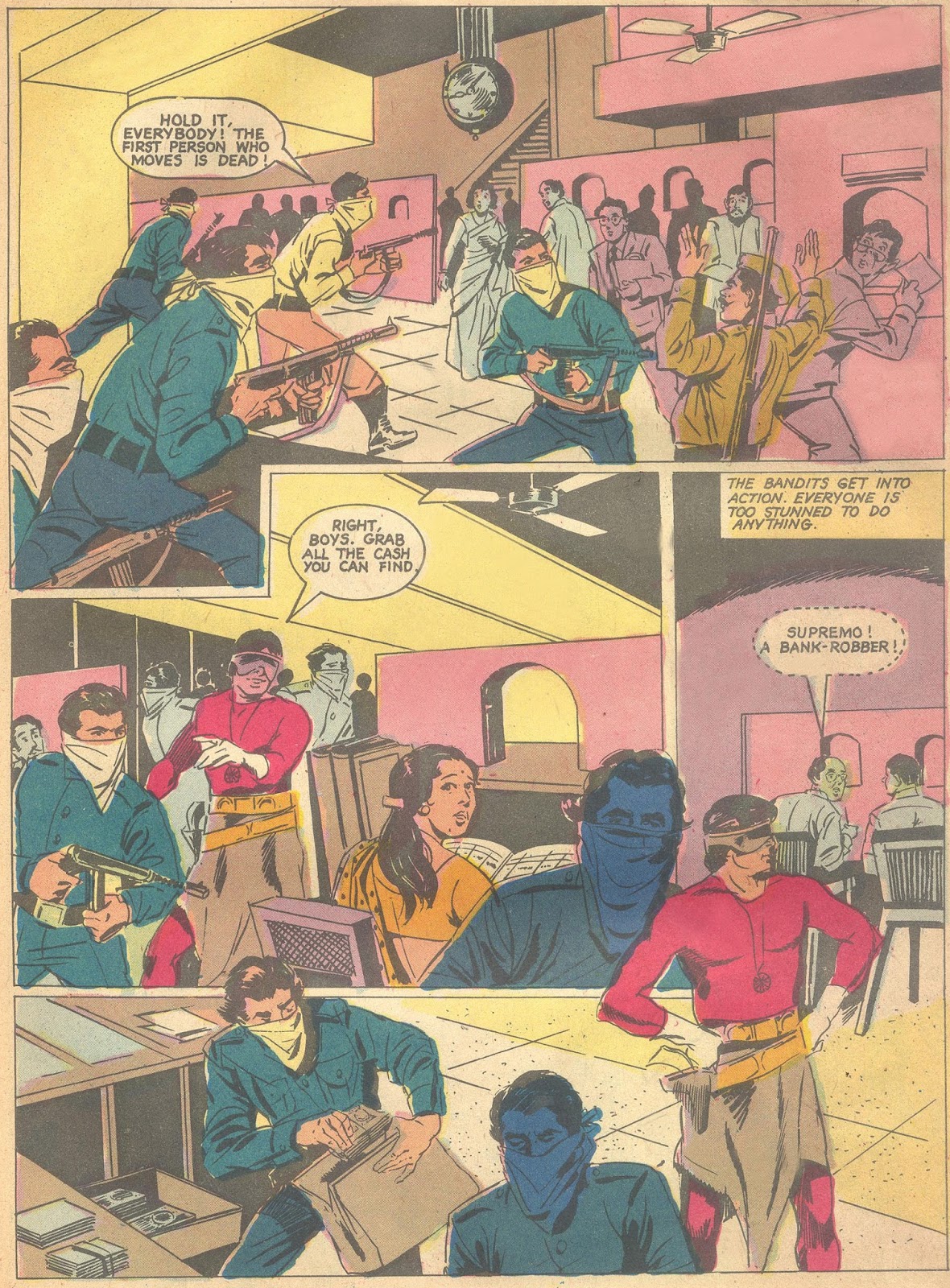
The story switches gear and we witness a daylight robbery. A gang of men with machine guns, matching uniforms, and their faces covered with handkerchiefs, storm into the State Bank Downtown branch on a busy morning. The robbers are led by Supremo himself!


Now, this was the first time I had seen Supremo in action and, um… let me just say I was taken aback. In my humble opinion, that is a terrible costume. I’m told Bachchan himself approved it from the many designs Pratap Mullick – legendary Indian comic book artist, best known for his run on Nagraj – had sent to him; which only begs the question: Why? I get that the character was heavily influenced by The Phantom, but not everyone can rock a pink unitard. That too with a loincloth over it. I hope that pendant has some interesting history. Maybe, in true Bollywood style, it was the aakhiri nishaani of Supremo’s mother? But more than that, I hope he can see in those ridiculous… sunglasses?

Incidents of Supremo and his minions popping out of a red van like jokers out of a clown car and robbing banks, jewellery stores, etc. increase day by day. The police are baffled how “the staunchest crime fighter” they knew could turn to a life of crime. Meanwhile, Bachchan learns of the “sensational” news while shooting for a film in Kashmir. Immediately, he applies for a leave for he must investigate who is smearing mud to his good name, as we Indians say. And because he has better workers’ rights than you and I do, his leave is approved instantly.


The Phantom influence on Supremo is far more prominent than I had thought, for Supremo too has his own private island with various animals living in harmony à la “The Ghost Who Walks”. But The Phantom is not the only classic comic book character Supremo takes inspiration from. Batman has his Robins, Supremo has Vijay and Anthony. Yup, Vijay and Anthony are named after two of Bachchan's most famous roles.


Anthony dresses way better than any kid I’ve ever known, to be honest.

To learn more about his impostor, Supremo goes undercover as a journalist to interview the guards at the banks and jewellery stores that were robbed recently. His disguise looks less like that of a journalist and more like that of Matches Malone, the criminal guise Batman uses to infiltrate Gotham’s criminal world from time to time. Nonetheless, the cover works and Supremo discovers a “peculiar kind of mud” at each location where the clown bandit car was parked. He takes a sample of the mud and goes to the Central Soil Research Institute, hoping that the scientists there will help him with further analysis of the red mud.


I checked, and although we don’t have a Central Soil Research Institute, we do have a Central Soil Salinity Research Institute in Karnal, Haryana. So yeah, close enough.

As it turns out, Supremo’s hunch was correct! That “peculiar kind of mud” is indeed not found in the city. With the help of a detailed soil map, Supremo learns that that special kind of red mud is found on the northern outskirts of the city, in a thickly forested area.

Supremo goes back to island to plan his next course of action, which although turns out to be just driving his car around looking for red mud, it gives us this glorious scene of Vijay and Anthony fishing by the lake where even though Anthony has his trousers half folded and his shirt off, he still has his top hat on. This is the coolest kid I’ve ever seen!


Eventually, they stumble upon a house in the forest. Given that it was pink in colour, I don’t see why it took them so long to find it. I mean, yeah, I get it, it’s deep in the jungle and everything, but it’s painted pink! After taking out the security, Supremo and Robins Vijay & Anthony sneak into the house only to walk straight into Impostor Supremo™ and his henchmen, who look suspiciously similar to Jethalal and Bulla.


Our heroes are locked in a room where the door is “electrically operated” but the “switch is outside,” while the bad guys walk away, presumably to rob another bank. Never to succumb under pressure, Supremo quickly hatches a plan to cause a short circuit, thereby unlocking the door to their cage. While Supremo replaces the fuse so they can have some light to investigate this pink house in the middle of the jungle, Vijay and Anthony discover the robbers’ plans. Since they are laid out in simple treasure hunt map style, Supremo and Vijay & Anthony waste no time in uncovering Impostor Supremo™’s next target: The head office of the Indian Bank!

Alas, Supremo is too late and, back in the city, Impostor Supremo™ has already taken hostages inside the bank and is making ludicrous demands to the negotiators outside. When Supremo finally does arrive on the scene, I was hoping for a who is the real Supremo? dilemma, but the police, and especially the Chief of Police, are quite trustworthy of Supremo. They will recognise “the staunchest crime fighter” anywhere!

With only half an hour at their disposal to meet the robbers’ demands, the Chief of Police, in his infinite wisdom, lets a vigilante take control of the operation. Supremo’s plan? He is going to switch off the lights in the bank building and the police will then storm in, shooting anyone standing.

That… does not sound right.

Right?


What?!

Supremo races to the top of the adjacent building, where he luckily stumbles on a “thick coil of rope”. I wonder what he would have done if he hadn’t found the rope. He has no superpowers, so he can’t fly off the edge of the building or jump across tall buildings in a single bound. Clearly, planning is not one of Supremo’s superpowers.

Supremo makes a loop of one end of the rope and tries to throw it around a pipe on the roof of the bank building, but since he is no cowboy (and he has no superpowers), he fails. Repeatedly. For ten minutes.

Fortunately, Supremo’s pet falcon, Shaheen – based on the falcon Allarakha from Bachchan’s film Coolie (1983) – arrives just in time to prevent Supremo from embarrassing himself further in front of the onlookers below.


After a “deathly journey” across the road, “about three hundred feet from ground level,” Supremo reaches the roof of the bank building. He descends cautiously and makes a quick assessment of the situation, instructing Shaheen to fly around the robbers to distract them while he throws a note to one of the hostages, asking them to “lie flat on the ground” when the lights go out. It would seem that Impostor Supremo™'s minions are worse shots than Stormtroopers because none of them could shoot Shaheen down!

Supremo then proceeds to locate the main switch and has a little déjà vu.


True to their word and unlike any police I’ve ever known, the cops storm in as soon as the lights go off. Safety of the hostages be damned, shoot anyone left standing!

Nonetheless, all’s well that ends well is what we believe in here in India. Now that the Impostor Supremo™ had been caught it was time to unmask him, Scooby Doo style.


Voilà!

I told you. Those sideburns were evil.

The story ends rather abruptly, with the Chief of Police thanking Supremo, but not Vijay & Anthony. Will we see friction in the family in the next issue? The comic does end with Anthony leaning on Supremo’s car, possibly breaking the fourth wall, staring directly into our souls and probably up to some nefarious scheme.


So, perhaps we will see some friction in the family indeed. But, then again, considering that the series halted publication years ago, maybe not.

***
A slightly reworked version of this post was featured on the Brown History Newsletter. You can read the piece here.